

The lupine is more than a splash of color in the garden. It is protection, symbol, and one of humanity’s oldest companions.
Everyone who has ever driven past a flowering lupine field knows that moment: you slow down, look again, and briefly wonder whether what you are seeing is even real. Those colorful flower spikes – blue, violet, pink, white, sometimes yellow – look almost painted. Yet this is a plant whose story reaches far beyond its beauty.
For centuries, myths and meanings have surrounded it. It was planted as a protective charm, given as a symbol of creativity, and used as a food source in times of need. At the same time, it is a pioneer plant that improves poor soils and is gaining renewed relevance in modern agriculture.
For botanical details, identification features, toxicity, and cultivation advice, visit the lupine plant profile. This article asks a different question: what has this plant meant to people – across thousands of years?
Bitter Lupines and Sweet Lupines – a Necessary Distinction
Before diving into history and symbolism, one brief but important clarification is needed. Because “lupine” does not simply mean lupine.
Most wild species naturally contain quinolizidine alkaloids – bitter compounds that are toxic to humans and many animals. This did not prevent people from using the plant for millennia, but it always required knowing what you were doing. The real turning point came in the 20th century, when the breeding of sweet lupines (Lupinus albus, Lupinus angustifolius, Lupinus luteus) produced cultivars whose alkaloid content is so greatly reduced that their seeds are edible without any processing.
This distinction runs through the entire history of the plant – and explains why it was used as food in some cultures, treated merely as green manure in others, and considered simply toxic in still others. All the details on toxicity, safe cultivars, and culinary use are in the plant profile.
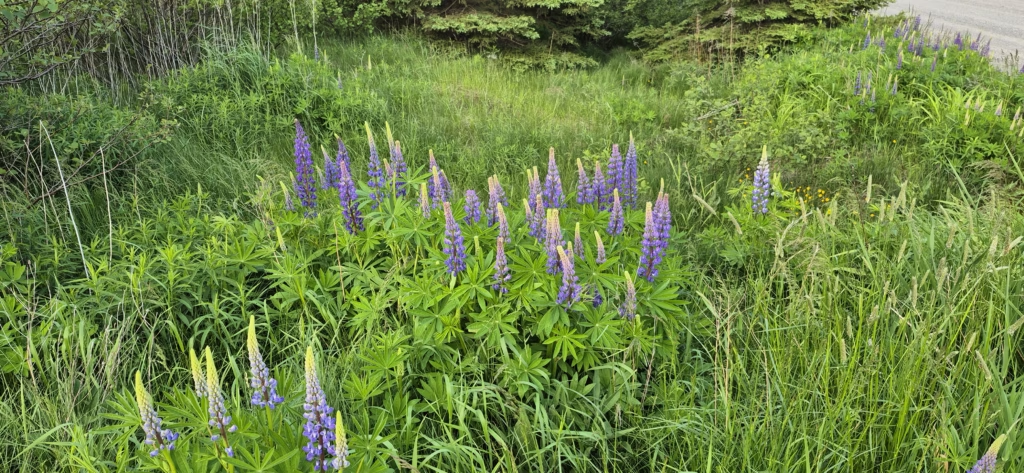

Protective Plant and Gateway to the Otherworld
Since antiquity, this flower was more than a useful crop. Entire fields were believed to ward off evil spirits. In some villages, plants were placed around houses and yards as living barriers against the unseen. The idea that a plant could offer protection and spiritual safety shows how closely nature and belief were intertwined in earlier times.
In pagan practices, it also played a role. Particularly at times of transition – the turn of the seasons, rituals marking new life stages – it was seen as a companion that brought luck and kept misfortune away. Its upright flower spikes were read as signs of strength and endurance, the variety of its colors as a symbol of life’s abundance.
What is worth knowing is that the name of the plant tells its own story. Lupine derives from the Latin lupus – wolf. This was not meant as a compliment. For a long time, people believed it ruthlessly stripped the soil of all its nutrients, leaving it as depleted as a wolf leaves its prey. We now know that the exact opposite is true – lupines fix nitrogen and actively enrich the soil. But the name stayed, and perhaps it still captures something real: not the plant’s effect on the soil, but its character. It is stubborn. It grows where others give up. It does not need favorable conditions to hold its ground. That quality is something people seem to have sensed all along – and trusted – long before anyone understood its biochemistry.
The Language of Flowers – and What the Lupine Means Within It
In the 19th century, the so-called language of flowers (Floriography) became a fixed part of social communication. In an era when feelings were rarely expressed openly, people communicated through blooms – each species carried a defined meaning.
In this tradition, the lupine stood for imagination, creative force, and appreciation for another person’s inner world. To give someone this flower was to say: I see your creativity. I value the way you think and dream.
That is a remarkably deep meaning for a plant so often dismissed as a roadside weed. It reminded people that dreams are not only worth having but worth tending. So it moved from mystical protector to messenger of creativity – a meaning that still resonates today when you stand before a flowering field and allow yourself, just for a moment, to stop.
Hope in Difficult Times
In times of war and hardship, the symbolism took on yet another dimension. The ability to thrive on barren, exhausted soils made it a symbol of endurance and hope. It was said that wherever these flowers grew, better times were coming.
Poets described their upright spikes as images of dignity and uprightness – proof that it is possible to remain standing even under the harshest conditions. This symbolic weight may be harder to feel today, but it makes one thing clear: this was never a neutral natural phenomenon for the people who lived with it. It was a companion, a comfort, a promise.
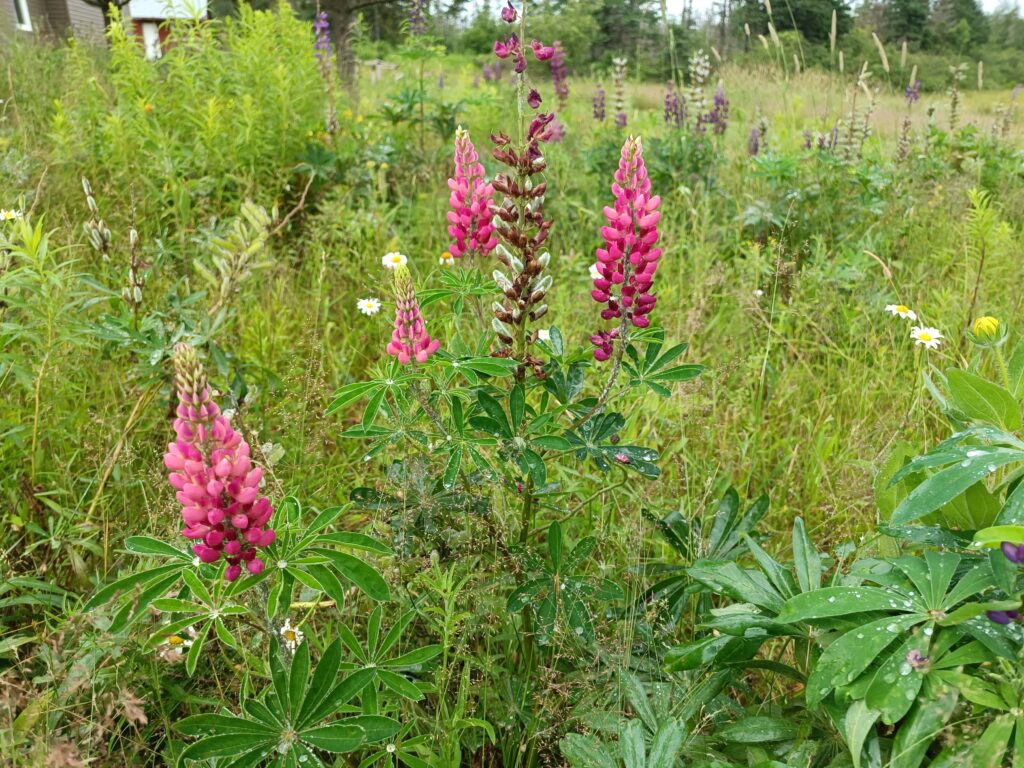


From the Andes to Ancient Europe – Historical Use
The lupine has accompanied humanity for over 3,000 years. Archaeological studies have found seeds in Egyptian tombs of the 12th Dynasty, placed there as provisions for the afterlife in the graves of kings and priests. The fact that they were included tells us what standing this plant held in the ancient world.
In South America
In the Andes, the tarwi lupine (Lupinus mutabilis) played a central role in the diet and culture of pre-Columbian peoples. Importantly, this was the wild form – a bitter variety with toxic alkaloids, inedible without treatment. Seeds had to be soaked for days in mountain streams and boiled several times to remove the bitterness. That level of effort speaks to how valuable it was: where animal husbandry is limited by altitude, any reliable protein source is worth the trouble. Only in the 20th century did the breeding of sweet lupines make this process unnecessary.
In Ancient Europe
Ancient authors including Pliny the Elder and Dioscorides wrote about it as an “improver of tired soils.” It was used as green manure in vineyards and on depleted fields: let it grow, cut it down, work it in. This practice was based on observation. The Romans did not know that the plant fixes atmospheric nitrogen in root nodules and makes it available to following crops. But they saw the result: soils that yielded better after a lupine season.
Through the Middle Ages, it remained an important agricultural tool – especially where nutrient-rich soils were scarce. A plant that improves the ground without taking from it is not a footnote in subsistence farming. It is a core instrument.
What Modern Research Confirms
What the Romans observed empirically, science has since fully explained – and considerably extended. Nitrogen fixation via root nodules, deep taproots as soil looseners, the role as a pollinator magnet: all of this is well documented and described in detail in the plant profile.
One thing that tends to get overlooked is its role as a preceding crop. The Romans knew it instinctively – today it can be measured. Soils where lupines have grown support more demanding following crops noticeably better. How exactly this can be used in a thoughtful crop rotation – which combinations make sense, what the timing requires, and what it means for smaller garden plots – is a topic we plan to cover in a dedicated article.
Research projects in recent years also show that the plant provides particularly valuable services in regions where conventional crops fail due to drought, poor soils, or difficult conditions. It is not just a useful plant. It is a systems tool.
A Bond Between Humans and Nature
The story of the lupine shows how closely nature and culture are interwoven. From the protective plant of ancient myth, to the messenger of creativity in the 19th century, to the modern pioneer in agriculture and climate research – it has taken on new roles again and again without losing its original strength.
What strikes us most: it has never done anything other than what it has always done. Grow upright. Enrich poor soils. Feed the bees. And look so beautiful while doing it that people have been stopping to stare for thousands of years.
Today, when we walk past a flowering field, we step into a space full of stories, scientific knowledge, and symbolism. This plant reminds us that flowers are more than decoration – they are part of our history, our food systems, our spirituality.

Sources & Further Reading
- Lupine Plant Profile
- PMC – Lupin seeds: nutritional properties and health benefits (Lupinus albus)
- Atchison et al. (2016) – Lost crops of the Incas: Origins of domestication of Lupinus mutabilis, American Journal of Botany
- INCREASE Project – Lupin: history, domestication and cultivation
- ScienceDirect (2024) – Climate-adapted alternative crops including lupine
Back to the main Page
Explore more Articles
more plants
Update notice: Originally published March 11, 2025, comprehensively revised May 2026.

Leave a Reply