When the next gardening season appears on the horizon, it is tempting to dive straight into seed catalogues and plant lists. But the really important decisions come earlier: before you know what to sow, you should know why you are gardening.
This article focuses on two fundamental questions:
What is the main goal of your garden?
Which eating habits do you want your garden to support?
Once you are clear on these two points, decisions about bed size, crop choice and workload become much easier.
Inhaltsverzeichnis
The main goal of your garden: what should this garden do for you?
Before you think about individual crops, it helps to ask yourself: What role should your garden play in your life?
Self-sufficiency, partial supply or pleasure garden?
A simple starting question is:
Should your garden provide as much of your food as possible?
Should it mainly supply you with fresh produce in summer?
Or is it more about favourite vegetables, berries and herbs to snack on and complement your meals?
Typical basic goals could be:
Self-sufficiency as a long-term direction
You plan so that a large part of your vegetables comes from your own garden – fresh in season and preserved for the colder months. This usually requires
enough space
storage and processing options
regular gardening time throughout the season.
Partial supply with a focus on summer cooking
Your garden mainly provides fresh ingredients during harvest time: salads, tomatoes, cucumbers, courgettes, herbs, some berries. Storage plays a smaller role. This is often
less work-intensive
more flexible if you do not want to plan the entire year in detail.
Pleasure and snack garden
The garden complements your shopping with things that are special to you: favourite varieties, rare vegetables, berries, herbs. The focus is on
taste and diversity
joy of harvesting
a manageable level of maintenance.
At this point, you can already decide whether you are moving more towards larger-scale vegetable production or towards a compact but intensive “gourmet garden”.
Time, energy and maintenance
The second foundation is sober but crucial: How much time and energy do you realistically have?
Helpful questions include:
How many hours per week can you spend in the garden during the main season – in real life, not in the ideal version of your schedule?
Do you work shifts or do you have relatively regular working hours?
Are you physically fit, or do you need a plan with less heavy work?
Do you get support from a partner, family or friends, or are you mainly responsible on your own?
From this follow some practical consequences:
If you only have a few hours per week, it makes sense to start with fewer beds, and focus on
robust crops
clear structures
good mulching and watering solutions.
If you can and want to spend a lot of time in the garden, you can plan for
more diversity
more complex mixed plantings
experiments and several planting rounds per season.
A garden that fits your everyday life will be more stable in the long run than a perfectly designed but overwhelming self-sufficiency dream.
The role of the garden in your daily life
Besides quantity and time, the function of the garden in your life matters. You can ask yourself, for example:
Should the garden mainly be practical (food, preserves, reduced grocery costs)?
Or is it also a place of retreat, where rest and recovery are important?
Do you want to use the garden as a learning space – for yourself, for children, for visitors?
Should the garden support biodiversity, for example with flowering strips, shrubs or small wild corners?
The clearer you answer these questions, the easier it becomes later to decide
how many different crops you really need
how densely you want to plant
whether you focus more on perennial structures (fruit trees, berries, perennial vegetables) or on annual crops.
For example:
If your garden is primarily meant to be a quiet, manageable retreat, a smaller, well-planned area with a few favourite crops can be more suitable than many beds that constantly feel “behind”.
Eating habits: what do you actually eat – and how often?
The next step is to align your actual diet with your garden.
Ideal diet vs everyday reality
Many people start their planning with the question: “What would be healthy or sustainable to eat?”
For a practical growing plan, however, it is helpful to first look at:
What ends up on your plate several times a week?
Which vegetables do you regularly use in the kitchen – and which ones tend to sit in the fridge despite good intentions?
It can help to
write down for two to four weeks which vegetables, pulses and herbs you really use, and
list your favourite dishes (soups, stir-fries, oven vegetables, salads, stews) and see which plants appear again and again.
This way you avoid two common problems:
You grow large quantities of crops that you actually eat only rarely.
You overlook those vegetables that you constantly buy, even though they would grow well in your garden.
A garden that is oriented towards your real eating habits will be more efficient and easier to integrate into everyday cooking.
Fresh, preserved or stored?
Your eating habits are closely linked to the question of how you want to use your harvest:
Do you want to eat most of it fresh – straight from the bed into the kitchen?
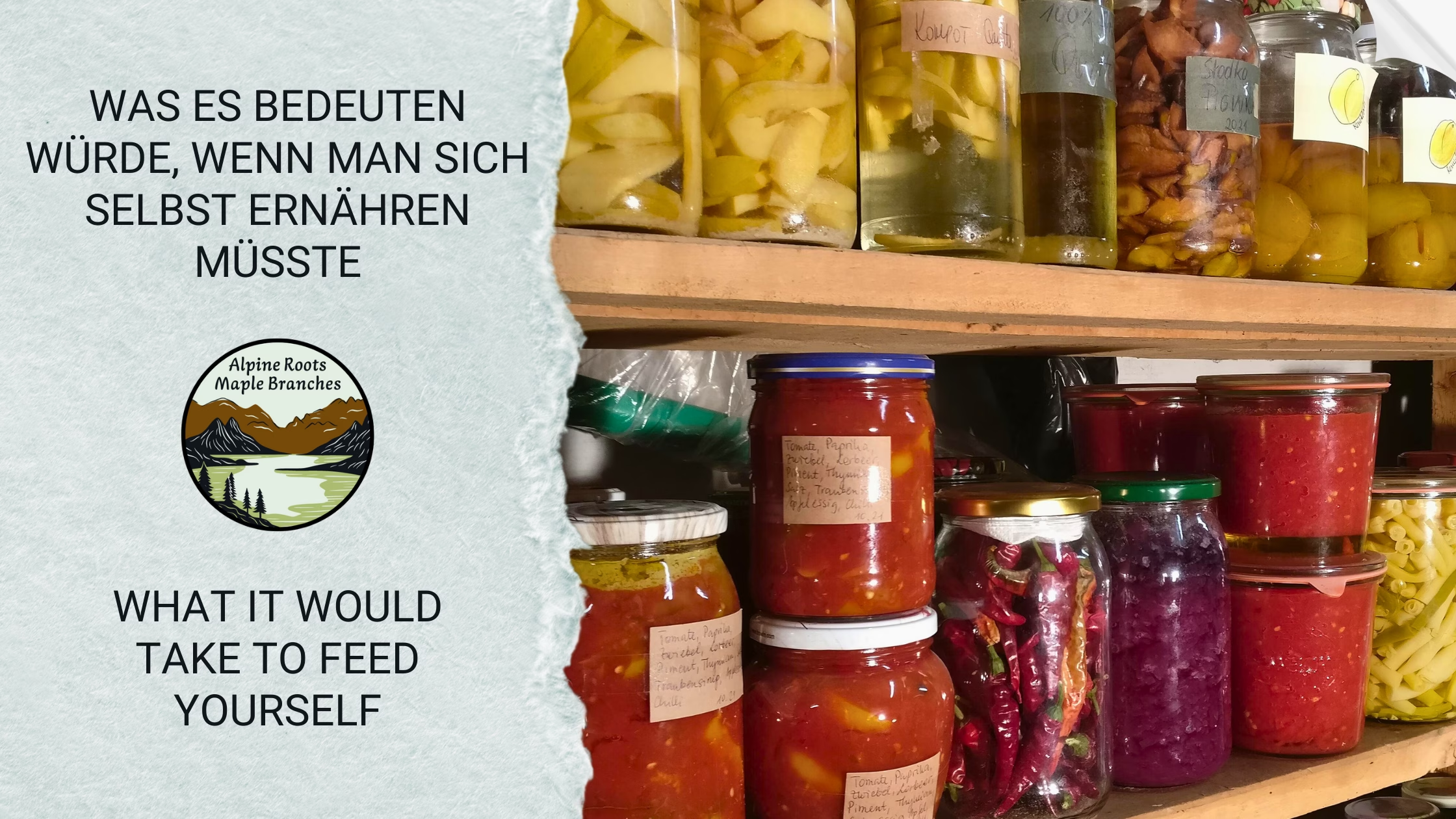
Do you want to build up a store of preserved food (bottling, fermenting, freezing, drying)?
Do you have suitable storage areas (cool room, cellar, freezer)?
From this, different focuses emerge:
If you mainly eat fresh, you need
well staggered sowings over the season
repeated sowings (for example lettuce, radishes, leafy greens)
fewer very large harvest peaks at once.
If you are planning for preserves, other crops become more important:
storage root vegetables
cabbages
tomatoes and peppers for sauces, soups and relishes
beans and peas for drying or freezing.
What matters here is not an abstract ideal, but:
how much time and energy you really want to invest in processing and preserving, and
how much storage capacity you actually have.
How many people – and how much do you need?
Even though this article does not yet calculate concrete plant numbers, it is still useful to think about for whom you are planning.
Single person, couple, family
A vegetable garden for one person looks different from a garden that is meant to partly supply a four-person household.
Helpful questions are:
For how many people do you cook regularly?
How often per week do you prepare meals with a significant vegetable share?
Are there people in the household who eat a lot of vegetables – or rather little?
For the first year in a new garden, it is often wise to
start with smaller amounts per crop, and
observe carefully:
Which beds are always harvested empty because everything is eaten right away?
Where do you clearly have too much and cannot keep up?
These observations are more valuable for future planning than theoretical tables.
From favourite meals to planting ideas
To move from eating habits to a realistic planting idea, you can work with your favourite meals.
For example:
If you cook a specific pasta dish with tomato sauce and fresh herbs twice a week, you can ask:
How many tomatoes would you need to cover part of this sauce in summer, and some more as preserves for winter?
Which herbs are essential (basil, oregano, thyme), and how many plants would you actually use?
If you regularly eat oven vegetables (for example carrots, beetroot, potatoes, onions), you can ask:
How often does this dish appear on your menu?
Which of these vegetables could you realistically grow and store yourself?
You do not need exact numbers at this stage.
The important step is that the question changes from
“What could I theoretically grow?”
to
“Which crops fit my real meals – and in what rough proportion?”
A look ahead: from goals and habits to concrete plans
Once you are clearer about the main goal of your garden and your eating habits, the next planning steps become much more concrete:
How much space do you have, and how intensively do you want to use it?
Which crops match both your climate and your everyday meals?
Where does it make sense to think about storage or processing later on?
The more honestly you answer these questions now, the better your future beds will match your real life – not just a wishlist.
A logical next step, and a good topic for a follow-up article, is to look at:
your location and climate,
the available space,
and your existing or planned infrastructure (compost, water supply, greenhouse, raised beds).
Together with your goals and eating habits, this forms a solid base for a garden that truly fits you and your household – season after season.